Showing posts with label Chan Chun Sing. Show all posts

Wednesday, 3 August 2022

A less stable, less predictable world: Chan Chun Sing


The world we live in.
At the 9th Singapore Economic Review Conference on 1 August, Education Minister Chan Chun Sing said:
"We should not assume that the next 50 years will be underpinned by the rule of law in a stable international security order.
Neither should we assume that any single global power will be overwhelmingly dominant; willing or able to underwrite the load and responsibilities of maintaining such a global security order.
In addition, we should also not assume that there will be a global trade and economic order founded on clear rules, predictable system of dispute settlement mechanism, or decisions largely premised on economic logic." Speech by Mr Chan Chun Sing, Minister for Education at the 9th Singapore Economic Review Conference | MOE


Friday, 5 November 2021

Governing a country responsibly is not easy especially in uncertain times: Chan Chun Sing


Governing a country responsibly is not easy especially in uncertain times.

Education Minister Chan Chun Sing shared some thoughts in his opening address and keynote speech at the 8th Singapore-China Forum on Leadership.

Monday, 1 November 2021

To avoid irrelevance, mindsets , systems, processes have to evolve with changing circumstances: Chan Chun Sing


Opening Address and Keynote Speech by Mr Chan Chun Sing, Minister for Education and Minister-in-charge of the Public Service at the 8th Singapore-China Forum on Leadership.
Nothing is set in stone. Change is the only constant. To avoid irrelevance, mindsets , systems, processes etc have to evolve with changing circumstances.
What worked in a set of circumstances may not work in different circumstances.


Sunday, 31 October 2021

To protect its cohesion and unity, every society needs to define its own identity and be able to refresh its social consensus on values and viewpoints as these evolve: Chan Chun Sing


In an inter-connected world, our society is also exposed to ideologies and movements that originated from other parts of the world, with different contexts and values systems.

"Some segments of our population may be influenced by such external forces without a full and critical appreciation of our local context or history," Education Minister Chan Chun Sing said.
"This has ignited the contestation of ideas and ideologies in society, resulting in more and deeper divides among the citizenry.
To protect its cohesion and unity, every society needs to define its own identity and be able to refresh its social consensus on values and viewpoints as these evolve," he added.

Tuesday, 14 September 2021

Chan Chun Sing and the closure of Yale-NUS College


Why weren't the student body and staff consulted?
Education Minister Chan Chun Sing said it was because the discussions involved the senior leadership of the two universities and with their respective boards on sensitive issues of strategy and finances.
Minister Chan said:
"𝐓𝐡𝐞 𝐜𝐨𝐬𝐭 𝐨𝐟 𝐞𝐝𝐮𝐜𝐚𝐭𝐢𝐨𝐧 𝐨𝐟 𝐚 𝐘𝐍𝐂 𝐬𝐭𝐮𝐝𝐞𝐧𝐭 𝐭𝐨𝐝𝐚𝐲 𝐢𝐬 𝐦𝐨𝐫𝐞 𝐭𝐡𝐚𝐧 𝐝𝐨𝐮𝐛𝐥𝐞 𝐭𝐡𝐚𝐭 𝐨𝐟 𝐚 𝐇𝐮𝐦𝐚𝐧𝐢𝐭𝐢𝐞𝐬 𝐨𝐫 𝐒𝐜𝐢𝐞𝐧𝐜𝐞𝐬 𝐬𝐭𝐮𝐝𝐞𝐧𝐭 𝐢𝐧 𝐍𝐔𝐒. 𝐋𝐢𝐤𝐞𝐰𝐢𝐬𝐞, 𝐛𝐨𝐭𝐡 𝐭𝐮𝐢𝐭𝐢𝐨𝐧 𝐟𝐞𝐞𝐬 𝐚𝐧𝐝 𝐠𝐨𝐯𝐞𝐫𝐧𝐦𝐞𝐧𝐭 𝐟𝐮𝐧𝐝𝐢𝐧𝐠 𝐚𝐫𝐞 𝐦𝐨𝐫𝐞 𝐭𝐡𝐚𝐧 𝐝𝐨𝐮𝐛𝐥𝐞.
But we accepted this because we saw value in having a liberal arts college in our tertiary system.
YNC hoped to raise over $300m to reach an endowment fund size of around $1 billion 𝐰𝐢𝐭𝐡 𝐠𝐨𝐯𝐞𝐫𝐧𝐦𝐞𝐧𝐭 𝐦𝐚𝐭𝐜𝐡𝐢𝐧𝐠 𝐚𝐧𝐝 𝐢𝐧𝐯𝐞𝐬𝐭𝐦𝐞𝐧𝐭 𝐫𝐞𝐭𝐮𝐫𝐧𝐬.
This would have reduced the burden on the annual operating income of fees and government subsidies. 𝐘𝐍𝐂 𝐡𝐚𝐬 𝐝𝐨𝐧𝐞 𝐢𝐭𝐬 𝐮𝐭𝐦𝐨𝐬𝐭 𝐢𝐧 𝐫𝐚𝐢𝐬𝐢𝐧𝐠 𝐟𝐮𝐧𝐝𝐬, 𝐛𝐮𝐭 𝐭𝐡𝐫𝐨𝐮𝐠𝐡 𝐧𝐨 𝐟𝐚𝐮𝐥𝐭 𝐨𝐟 𝐢𝐭𝐬 𝐨𝐰𝐧 𝐡𝐚𝐬 𝐧𝐨𝐭 𝐫𝐞𝐚𝐜𝐡𝐞𝐝 𝐢𝐭𝐬 𝐭𝐚𝐫𝐠𝐞𝐭.
Transitioning to the New College will give us economies of scale, and reduce costs to some extent. This was a relevant consideration, but not the main motivation for the change." (end of quote)
What we also learn from an article from Yale Daily:
45% of each intake at Yale-NUS are foreign students.
The article wrote:
"Yale-NUS required resources from the Singaporean government, and many of the funds financed the education of foreign talent. According to a previous article reported in the News at the time of Yale-NUS’ conception, the government of Singapore was meant to finance the college for at least its first decade, but administrators also tried to build up an endowment. Officials hoped the endowment would be on par with those of Williams College and Amherst College, which were valued at about $1.5 billion at the time, according to a 2008 Ministry of Education report.
𝐁𝐮𝐭 𝐘𝐚𝐥𝐞 𝐝𝐞𝐜𝐢𝐝𝐞𝐝 𝐧𝐨𝐭 𝐭𝐨 𝐭𝐚𝐩 𝐢𝐧𝐭𝐨 𝐢𝐭𝐬 𝐞𝐱𝐢𝐬𝐭𝐢𝐧𝐠 𝐝𝐨𝐧𝐨𝐫 𝐩𝐨𝐨𝐥 𝐚𝐧𝐝 𝐩𝐨𝐭𝐞𝐧𝐭𝐢𝐚𝐥𝐥𝐲 𝐝𝐢𝐯𝐞𝐫𝐭 𝐟𝐮𝐧𝐝𝐬 𝐚𝐰𝐚𝐲 𝐟𝐫𝐨𝐦 𝐢𝐭𝐬 𝐔.𝐒.-𝐛𝐚𝐬𝐞𝐝 𝐩𝐫𝐨𝐠𝐫𝐚𝐦𝐬 𝐚𝐧𝐝 𝐜𝐚𝐦𝐩𝐮𝐬, 𝐭𝐡𝐞 𝐍𝐞𝐰𝐬 𝐫𝐞𝐩𝐨𝐫𝐭𝐞𝐝 𝐢𝐧 𝟐𝟎𝟏𝟏. While the Singaporean government funded the college’s construction and subsidized most of the costs in its first decade, the college aimed to be funded by one-third government subsidy, one-third tuition and other fees and one-third gifts and endowments by 2030, according to The Octant." (end of quote)
So we can gather from what Mr Chan said and from the article from Yale Daily that Yale did not want to fund the college.
So here's what it is:
The Singapore government funded the construction of the college and subsidised the very expensive cost of education at Yale-NUS.
And almost half the enrolment in the college are international students with an education financed by the Singapore's taxpayers. That's a very high proportion of foreign students.
Yale did not want to contribute funds to this college.
Well, looking at these facts, it makes perfect sense to merge Yale-NUS with USP to form a new college for economy of scale, to make education more affordable (and therefore more inclusive) to Singaporeans.
NUS is a leading university. There's no reason why a merge college cannot do well or even better.


Education Minister Chan Chun Sing's reply to the question on the impact of the merger of Yale-NUS and USP (University Scholars Programme) on academic freedom:
𝐓𝐡𝐚𝐭 𝐭𝐨𝐝𝐚𝐲, 𝐘𝐚𝐥𝐞-𝐍𝐔𝐒 𝐂𝐨𝐥𝐥𝐞𝐠𝐞 (𝐘𝐍𝐂) 𝐢𝐬 𝐬𝐞𝐞𝐧 𝐚𝐬 𝐭𝐡𝐞 𝐩𝐚𝐫𝐚𝐠𝐨𝐧 𝐨𝐟 𝐚𝐜𝐚𝐝𝐞𝐦𝐢𝐜 𝐟𝐫𝐞𝐞𝐝𝐨𝐦 𝐢𝐬 𝐭𝐞𝐬𝐭𝐢𝐦𝐨𝐧𝐲 𝐨𝐟 𝐭𝐡𝐞 𝐞𝐟𝐟𝐨𝐫𝐭𝐬 𝐨𝐟 𝐍𝐔𝐒 𝐚𝐧𝐝 𝐘𝐍𝐂.
1. First, there had been similar concerns about a perceived lack of academic freedom when YNC was established. They proved unfounded.
In fact, few believed then that YNC would live up to its ambition. Even fewer would own it. It is perhaps ironic, and a testimony to NUS and YNC’s efforts all these years, that YNC is now seen as a paragon of academic freedom in Singapore.
2. 𝐘𝐍𝐂’𝐬 𝐜𝐮𝐫𝐫𝐞𝐧𝐭 𝐩𝐨𝐥𝐢𝐜𝐢𝐞𝐬 𝐨𝐧 𝐚𝐜𝐚𝐝𝐞𝐦𝐢𝐜 𝐟𝐫𝐞𝐞𝐝𝐨𝐦 𝐰𝐞𝐫𝐞 𝐢𝐧 𝐟𝐚𝐜𝐭 𝐟𝐫𝐚𝐦𝐞𝐝 𝐛𝐲 𝐭𝐚𝐤𝐢𝐧𝐠 𝐫𝐞𝐟𝐞𝐫𝐞𝐧𝐜𝐞 𝐟𝐫𝐨𝐦 𝐍𝐔𝐒’𝐬 𝐩𝐫𝐚𝐜𝐭𝐢𝐜𝐞𝐬 𝐫𝐞𝐥𝐚𝐭𝐢𝐧𝐠 𝐭𝐨 𝐚𝐜𝐚𝐝𝐞𝐦𝐢𝐜 𝐟𝐫𝐞𝐞𝐝𝐨𝐦, 𝐚𝐧𝐝 𝐭𝐡𝐞𝐬𝐞 𝐩𝐫𝐚𝐜𝐭𝐢𝐜𝐞𝐬 𝐡𝐚𝐯𝐞 𝐫𝐞𝐦𝐚𝐢𝐧𝐞𝐝 𝐮𝐧𝐜𝐡𝐚𝐧𝐠𝐞𝐝 𝐬𝐢𝐧𝐜𝐞 𝐭𝐡𝐞𝐧.
𝐓𝐡𝐞 𝐟𝐚𝐜𝐮𝐥𝐭𝐢𝐞𝐬 𝐨𝐟 𝐚𝐫𝐭𝐬 𝐚𝐧𝐝 𝐬𝐨𝐜𝐢𝐚𝐥 𝐬𝐜𝐢𝐞𝐧𝐜𝐞𝐬 𝐢𝐧 𝐍𝐔𝐒 and other Autonomous Universities (AUs) also have 𝐡𝐚𝐝 𝐚 𝐥𝐨𝐧𝐠 𝐡𝐢𝐬𝐭𝐨𝐫𝐲 𝐨𝐟 𝐭𝐞𝐚𝐜𝐡𝐢𝐧𝐠 𝐚𝐧𝐝 𝐫𝐞𝐬𝐞𝐚𝐫𝐜𝐡, 𝐢𝐧𝐜𝐥𝐮𝐝𝐢𝐧𝐠 𝐨𝐧 𝐩𝐨𝐭𝐞𝐧𝐭𝐢𝐚𝐥𝐥𝐲 𝐬𝐞𝐧𝐬𝐢𝐭𝐢𝐯𝐞 𝐚𝐧𝐝 𝐝𝐢𝐟𝐟𝐢𝐜𝐮𝐥𝐭 𝐭𝐨𝐩𝐢𝐜𝐬, 𝐥𝐨𝐧𝐠 𝐛𝐞𝐟𝐨𝐫𝐞 𝐭𝐡𝐞 𝐞𝐬𝐭𝐚𝐛𝐥𝐢𝐬𝐡𝐦𝐞𝐧𝐭 𝐨𝐟 𝐘𝐍𝐂.
𝐓𝐡𝐞𝐲 𝐚𝐫𝐞 𝐡𝐢𝐠𝐡𝐥𝐲-𝐫𝐚𝐧𝐤𝐞𝐝 𝐠𝐥𝐨𝐛𝐚𝐥𝐥𝐲, and attract distinguished scholars. It would be grossly unfair to faculty members in NUS and other AUs to suggest that their teaching or research is in any way less rigorous, of lower quality or less free than that of YNC faculty.

Thursday, 22 April 2021

Overheard on Chan Chun Sing

 #overheard 1

He hardly had any sleep last year and when lack of sleep, words might not be what he thinks. He’s really impressive to do everything positively and still walk around and care for his grc. So much efforts, time and mental power !
We even have eggs from Poland and Ukraine! Basic essential items’ supplies and so much more mnc based here and create so much more job opportunities.
Just that tiny mistake and get boo... it’s really a bully act of a coward !
Yes, you made fun of the man who mistakenly said Cotton came from Sheep during an interview on the difficulty of importing materials to make surgical masks last year.
But the same man and his team brought in $17.2b of investments in 2020. Despite the pandemic and the recession, it was a 12-year high.
The same man secured our supplies for food and other daily necessities and made sure that there was no panic among the population.
So laugh all you want at Chan Chun Sing but don't forget the contributions he gave to Singapore in all his adult life.

Monday, 19 April 2021

Helping ourselves when we help people


Our own experience is that it also makes us more grateful and appreciative of what we do have.
Monday, 12 April 2021

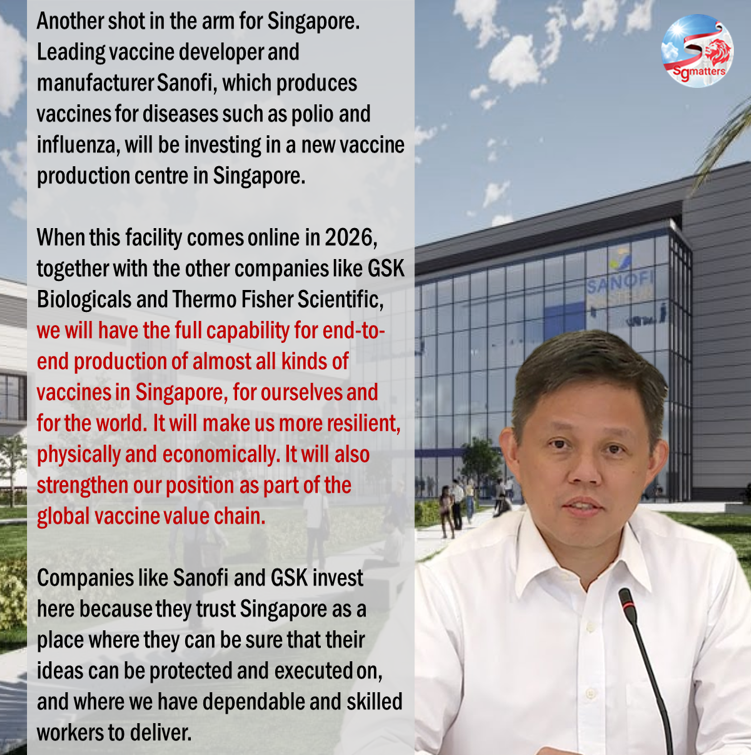
Leading vaccine developer and manufacturer Sanofi will be investing in a new vaccine production centre in Singapore


A good shot!

"Leading vaccine developer and manufacturer Sanofi, which produces vaccines for diseases such as polio and influenza, will be investing in a new vaccine production centre in Singapore. Sanofi will invest €400 million and hire up to 200 locals over five years to create a state-of-the-art facility in Singapore that can produce multiple vaccines in one go.
When this facility comes online in 2026, together with the other companies like GSK Biologicals and Thermo Fisher Scientific, we will have the full capability for end-to-end production of almost all kinds of vaccines in Singapore, for ourselves and for the world. It will make us more resilient, physically and economically. It will also strengthen our position as part of the global vaccine value chain.
Companies like Sanofi and GSK invest here because they trust Singapore as a place where they can be sure that their ideas can be protected and executed on, and where we have dependable and skilled workers to deliver."
- Trade and Industry Minister Chan Chun Sing

Friday, 9 April 2021

Opposition targets Chan Chun Sing because they see him as a threat!


Opposition supporters target Chan Chun Sing because they see him as a threat. They mock at him when he speaks the common man lingual even as they charge that PAP MPs are elitist and not in touch with the common man on the ground.

Yet they haven't done a fraction as much for the country as Mr Chan has done, first serving in the army and then as a politician to improve the lives of Singaporeans.

Under his watch, MTI attracted investments that exceeded target in challenging circumstances, creating thousands of jobs for Singaporeans.

Few people know that he was inducted into the hall of fame of the United States Army Command and General Staff College considered by many as the intellectual centre of the US Army.

Mr Chan excelled as a student at the US Army Command and General Staff College in 1998, and was the first foreign student to be conferred the "Distinguished Master Strategist Award" in the same year.

Like the rest of the PAP Ministers, he serves Singapore with his whole heart and soul, putting Singapore and Singaporeans' interests first. 

Wednesday, 17 March 2021

Trust is a function of mutual interdependence and track record: Chan Chun Sing at the Nikkei Forum Innovative Asia 2021


At the Nikkei Forum Innovative Asia 2021, a hybrid event held at Suntec Singapore Convention Centre and broadcast live to over 500 business professionals, officials and academics in the region and across the world, Trade and Industry Minister Chan Chun Sing talked about the the challenges and aspirations of global businesses.

He said:
Trust will become an even more important factor with increased geopolitical uncertainties.
Interdependence, rather than independence, will provide greater diversity and resilience to our supply chains.
We are all safer if we have a shared interest in each other’s prosperity.
But trust is not a function of geographical distances. Trust is a function of mutual interdependence and track record.
This is the reason why Singapore will do our utmost, even in the depth of the COVID-19 pandemic, to allow companies sited here to fulfil their international commercial obligations, never restricting exports for our benefit but to the detriment of others.
This is also the same reason why we have done the same thing during the Oil Embargo in the 1970s. That has helped us to cement the trust which the world placed in us and allow us to grow Jurong Island to become one of the foremost petrochemical hubs in the world today.
In the search for stable long-term returns, policy consistency and business environment predictability are critical considerations for businesses.
This is why Singapore pays so much attention to this.
We say what we mean, and we mean what we say.
We will keep our promises and deliver on them.
- Excerpt of speech

Saturday, 20 February 2021

We don't fall in love with our plans: Chan Chun Sing


Finance Minister Goh Keng Swee was one of the chief architects of our early economic and national development. When asked later about his visionary role, Dr Goh said: "I had no initial vision. You just start it and hope for the best."

It's not that Dr Goh set out with no aim or direction in mind. It's about agility, humility and learning by doing. We don't fall for our own plans, or let that blind us from challenging our own assumptions.
For Singapore, we distil the essence from different countries, different models, and tailor them to our own unique context.
I think of our "model" of governance as one that evolves with time and in context. This is something that we have never taken for granted, and is always a work in progress.
So instead of getting caught up in theoretical debates, we need to understand what works best for us, and apply it boldly, creatively and judiciously.
As a nation, we have weathered numerous crises, precisely because we have never been dogmatic about our approach.
- Chan Chun Sing
Read speech by Minister Chan Chun Sing here: https://www.straitstimes.com/opinion/evolve-adapt-innovate-spores-keys-to-the-future

Monday, 15 February 2021

Singapore has to act now to re-think our processes, our value proposition and how we can build a new economy: Chan Chun Sing


Trade and Industry Minister Chan Chun Sing said that we are starting 2021 with cautious optimism and hopeful of some global economic recovery in the second half of the year.

However, uncertainties remains and the global rollout of vaccination is not a silver bullet.
"That is why Singapore has to act now to re-think our processes, our value proposition and how we can build a new economy by transforming ourselves, in order to seize the opportunities available amidst the crisis," he said.
"The faster we are able to do this collectively, the sooner and the better we will be able to seize the growth opportunities available and be ready for the recovery when it comes."
Our role as a business hub will changed. We will no longer be an intermediary matching supply and demand.
We will endeavour to be a business hub that cannot be easily displaced, "where we offer the services of being able to mobilise capital, aggregate talent, protect intellectual property, and provide a predictable environment for businesses to thrive, not just to serve any particular domestic market, but to serve international markets."
In crisis, there is opportunity.
"The digital world presents fresh opportunities that are up for grabs for those who are willing to try. Technology is neutral. Whoever who can master technology best will win. This applies to us and our businesses as well. So, it is not about technology per se. It is about how we position ourselves in this rapidly transforming world," Mr Chan said.

Thursday, 11 February 2021

Energy will be our next challenge after water


Have confidence.

In the last 50 years, we work to overcome our water challenges. In the next 50 years, we can also solve the energy challenge. Let's work together as one united people.

Thursday, 21 January 2021

Lesson from Covid-19 : Money alone is not enough.


Money alone is not enough.

Trade and Industry Minister Chan Chun Sing said Singapore was able to attract $17.2 billion in fixed asset investments in 2020 despite the pandemic gloom because of competence and good governance, the trust premium that undergirds our regulatory system and Intellectual Property regime and our skilled workforce.
𝐀𝐝𝐝𝐢𝐭𝐢𝐨𝐧𝐚𝐥𝐥𝐲, 𝐰𝐞 𝐦𝐚𝐝𝐞 𝐭𝐡𝐞 𝐞𝐟𝐟𝐨𝐫𝐭𝐬 𝐭𝐨 𝐤𝐞𝐞𝐩 𝐨𝐮𝐫 𝐛𝐨𝐫𝐝𝐞𝐫𝐬 𝐨𝐩𝐞𝐧, 𝐦𝐚𝐢𝐧𝐭𝐚𝐢𝐧 𝐞𝐱𝐭𝐞𝐫𝐧𝐚𝐥 𝐜𝐨𝐧𝐧𝐞𝐜𝐭𝐢𝐯𝐢𝐭𝐲 𝐚𝐧𝐝 𝐡𝐞𝐥𝐩 𝐞𝐧𝐬𝐮𝐫𝐞 𝐛𝐮𝐬𝐢𝐧𝐞𝐬𝐬 𝐜𝐨𝐧𝐭𝐢𝐧𝐮𝐢𝐭𝐲. 𝐓𝐡𝐞𝐬𝐞 𝐞𝐟𝐟𝐨𝐫𝐭𝐬 𝐡𝐚𝐯𝐞 𝐠𝐢𝐯𝐞𝐧 𝐠𝐥𝐨𝐛𝐚𝐥 𝐜𝐨𝐦𝐩𝐚𝐧𝐢𝐞𝐬 𝐭𝐡𝐞 𝐜𝐨𝐧𝐟𝐢𝐝𝐞𝐧𝐜𝐞 𝐭𝐨 𝐜𝐨𝐧𝐭𝐢𝐧𝐮𝐞 𝐭𝐨 𝐬𝐢𝐭𝐞 𝐭𝐡𝐞𝐢𝐫 𝐩𝐫𝐨𝐣𝐞𝐜𝐭𝐬 𝐢𝐧 𝐒𝐢𝐧𝐠𝐚𝐩𝐨𝐫𝐞.
On social media, there are people who simply cannot understand the importance of keeping our borders open. They have a reaction each time imported cases are announced. They don't understand that their own future would be at stake if we shut our borders.
Shutting borders is not an option. Managing imported cases is the option. And Singaporeans ourselves must not be complacent or we will have clusters in the community because we fail to remove ourselves from the community when we are sick.

Wednesday, 13 January 2021

Chan Chun Sing on Malaysia's state of emergency and bilateral supply chains


Some Singaporeans don't realise that Ministers like Chan Chun Sing bear the heavy responsibility of ensuring that Singaporeans have food to fill their stomach. So they make jokes whenever he shared photos of delivery of eggs or essential items..

With Malaysia going into a state of emergency, once again, we are confronted with the possibility that supplies from up north could be affected.
But so far so good. Here's what Min Chan said in a Facebook post:
"During my visit to DuPont this morning, I was asked by the media to comment on the impact of Malaysia’s Movement Control Order and State of Emergency on our supply chains.
Through the course of the pandemic, we always have to prepare for potential disruptions to our supplies and supply chains. Over the last few months in particular, we have seen how quickly new clusters can emerge and spread, resulting in governments around the world having to take tough measures to control the transmission of the virus, sometimes disrupting the supply chains.
We are in close contact with our Malaysian counterparts regarding the latest moves they have taken to prevent the virus from spreading further. We are both committed to working closely together to maintain the integrity and interdependence of our bilateral supply lines. Over the last two days, there have been no disruptions to our supply chains and goods have continued to flow freely between our countries.
In light of the uncertain global situation, Singapore has continued to build up a healthy stockpile of essential food items. We have also strengthened our diversification efforts and opened up new supply lines with many other countries. Strengthening our supply chain resilience is a never ending job and we will continue to press on with these efforts.
As the pandemic continues, it is important that we all remain vigilant. I want to assure Singaporeans that our supply chains are continually being diversified and strengthened We are quietly confident but not complacent. I also thank Singaporeans for staying calm and adaptable amidst the evolving situation which has allowed us to better mitigate potential disruptions and stay resilient.

Thursday, 31 December 2020

Chan Chun Sing: we don't fall in love with our plans


It's been a very challenging year, a year that challenges our survival, both in terms of health, and in terms of economy. But everyone at the Ministry of Trade and Industry has been working very hard to secure Singapore's future.

"Since its founding, EDB has been a key driver of Singapore’s economic growth and development.
𝐄𝐯𝐞𝐧 𝐚𝐦𝐢𝐝𝐬𝐭 𝐭𝐡𝐞 𝐂𝐎𝐕𝐈𝐃-𝟏𝟗 𝐩𝐚𝐧𝐝𝐞𝐦𝐢𝐜, 𝐄𝐃𝐁 𝐦𝐚𝐧𝐚𝐠𝐞𝐝 𝐭𝐨 𝐬𝐞𝐜𝐮𝐫𝐞 𝐦𝐨𝐫𝐞 𝐭𝐡𝐚𝐧 𝐒$𝟏𝟑 𝐛𝐢𝐥𝐥𝐢𝐨𝐧 𝐨𝐟 𝐟𝐢𝐱𝐞𝐝 𝐚𝐬𝐬𝐞𝐭 𝐢𝐧𝐯𝐞𝐬𝐭𝐦𝐞𝐧𝐭 𝐜𝐨𝐦𝐦𝐢𝐭𝐦𝐞𝐧𝐭𝐬 𝐢𝐧 𝐭𝐡𝐞 𝐟𝐢𝐫𝐬𝐭 𝐟𝐨𝐮𝐫 𝐦𝐨𝐧𝐭𝐡𝐬 𝐨𝐟 𝟐𝟎𝟐𝟎.
EDB’s and Singapore’s success have been premised on three sets of ethos:
First, a cleared-eye assessment of the wider global trends impacting us;
Second, the ability to make hard-nosed decisions on what is necessary, and to adapt to evolving situations, and
Third, a dogged determination to pursue our objectives once we have decided on our direction."
- Trade and Industry Minister Chan Chun Sing

Thursday, 10 December 2020

Our strategy is one of RISK MANAGEMENT, and NOT RISK ELIMINATION, says Trade and Industry Minister Chan Chun Sing.


Our strategy is one of RISK MANAGEMENT, and NOT RISK ELIMINATION, says Trade and Industry Minister Chan Chun Sing.

Risk management involves taking risk and managing that risk when it happens. Risk elimination means doing nothing, no resumption of activities.
Obviously, risk elimination is out of the question. We've been told more than once that as we move towards Phase 3 and resume more activities, we should also expect more COVID0-19 cases. This is something we must be mentally prepared so that whenever a case emerges, we do not have a knee jerk reaction or swing to an extreme and call for a cessation of activities.
Why risk management? Mr Chan explained earlier in a speech on Nov 25 at TravelRevive that Singapore's reliance on external connections and visitors necessitates us to adopt a “risk management” instead of a “risk elimination” approach.

Wednesday, 9 December 2020

The World Economic Forum's decision to move next year Annual Special Meeting to Singapore is a reflection of the trust and confidence that the international community has in Singapore


𝐖𝐡𝐨𝐞𝐯𝐞𝐫 𝐠𝐨𝐯𝐞𝐫𝐧𝐬 𝐒𝐢𝐧𝐠𝐚𝐩𝐨𝐫𝐞 𝐦𝐮𝐬𝐭 𝐡𝐚𝐯𝐞 𝐭𝐡𝐞 𝐢𝐫𝐨𝐧 𝐢𝐧 𝐭𝐡𝐞𝐦.

At the height of the COVID crisis in Singapore, the taskforce soldiered on with a steadfast spirit and a clear focus, drawing up their long-term plans, never once letting the brickbats deter them from their task.
The World Economic Forum's decision to move next year Annual Special Meeting to Singapore is a reflection of the trust and confidence that the international community has in Singapore's ability not only to control the virus, but to keep participants safe.
Trade and Industry Minister Chan Chun Sing said:
Covid-19 has affected many countries in the world, bringing global travel and events to a standstill. Singapore has not been spared and has been harder hit than many countries due to our lack of a domestic market.
However, we did not allow the challenges to hold us back. Over the last two months, we successfully organised the Singapore International Energy Week 2020 and TravelRevive 2020, adopting innovative and safe travel and event protocols.
As we get ready to host the WEF Special Annual Meeting next year, we will ensure that the health and safety of our people and participants remain our top priority.