Tuesday, 31 May 2016

What will Singapore be like 20 years from now?


The Singapore 20 years from now will be an innovative and deeply inclusive one, where a new generation of Singaporeans define their own purpose in life, each with a sense of individuality, in a society that is bound together and at home with itself, said Deputy Prime Minister Tharman Shanmugaratnam yesterday.

Painting a picture of what the Republic will be like in 2035, based on a poll of students, he said: "Twenty years from now, we will still be a little red dot, always will be.

"But it will be a deep red dot. The colour of the Singapore heart."

Education, he said, would become more holistic, flexible and encouraging.

A more flexible system and a focus on skills and job performance, rather than qualifications earned early in life, will be needed instead for the fluid job market of the future, noted Mr Tharman.

Citing an informal survey MOE did to find out the aspirations of seminar participants, Mr Tharman noted that students ranked job satisfaction and the ability to make the most of one's talents, above factors like pay and career progress. Most also felt the Singapore of the future has to be innovative and inclusive.

Whether or not these aspirations could be met would depend on how Singapore reacts to changes in areas such as technology and geopolitics, said Mr Tharman.

Some jobs - such as software engineers, data scientists and healthcare professionals - could be in demand, while demand for lawyers, accountants and real estate or insurance agents could taper off.

While there is a "real fear" in many advanced countries that the jobs lost will outstrip the jobs created, Singapore can avoid that by responding in advance to what is coming, said Mr Tharman.

Studies show it is more productive for humans to "cobot" - collaborate with robots - than to have enterprises that rely purely on humans or robots alone.

Education will also evolve, with a premium on original thinking, which breeds the innovative spirit.

The way students and parents go about selecting schools will change, he said, with people valuing schools that develop their interests rather than schools with the highest cut-off scores.

But there is a "deeper tension" between innovation and inclusiveness, said Mr Tharman.

**While young Singaporeans will have a stronger sense of individuality, Singapore must not become an individualistic society but maintain a "spirit of solidarity" with "diversity of thinking" .

"It is a tension, but how this plays out depends on us," said Mr Tharman.

Mr Tharman was speaking at the opening ceremony of the Pre-University Seminar held at the Nanyang Technological University.

http://www.straitstimes.com/singapore/spore-in-2035-inclusive-and-innovative

MEDIA CENSORSHIP: Not the only test for a liberal progressive society


There is more freedom now compared to a decade ago, “let alone when I was your age”, said Mr Tharman. “I was a dissident, a government critic. It was completely different then, compared to where it is now. We have evolved into a society that has more freedoms, but it has some restrictions and they serve a purpose.”

He was speaking at a Pre-University Seminar on May 30 2016.

Singapore society should evolve towards more freedom of speech but some restrictions, such as on hate speech, are necessary.

Enforcement against hate speech does not mean all comment and expression is scrubbed out, but individuals have to be responsible, he said.

Mr Tharman spoke of the need to let values in Singapore “evolve quietly”, instead of having a debate to decide on values for the future, because that was not how societies evolved.

Each generation, he added, would have its own sense of purpose and values, but rarely totally divorced from their parents’ or grandparents’.

Media censorship, Mr Tharman said, was not the only test of a liberal, progressive society.

In some countries with looser reins on the media, there is much less freedom to walk safely on the streets and to advance oneself regardless of ethnicity or religion, he said.

Society has to find the right balance and some freedoms have to be curbed for it to evolve in a way that advances other freedoms, he said. “Every society faces this. We haven’t found the perfect balance, and we have to keep evolving.”

http://www.todayonline.com/singapore/more-freedom-speech-some-restrictions-necessary-dpm

Monday, 9 May 2016

Key drug threats facing Singapore


There is a growing calls for countries to legalize drugs and to adopt "harm reduction" approaches, that is, minimise the harms associated with drug use.

And THAT includes providing clean needles for drug abusers and safe, supervised injection sites.

So taxpayers will be funding some people's drug habit and addiction??

And this would be unacceptable to the majority of Singaporeans, said Mr Shanmugam.

Much of the impetus for harm reduction was coming from countries which were either major drug producers or have been affected by a large number of drugs flowing through their system and they are unable to cope with it anymore.

But Singapore is not in such a position.

Without its strict laws, the country would be swamped with drugs.

The Republic is near the Golden Triangle of Myanmar, Laos and Thailand - the second largest heroin production centre in Asia.

Singapore's standing as an international hub means even drugs from Afghanistan - another major heroin producer - could end up here.

"The death penalty for traffickers, in our experience, has played a key role in combating drug trafficking. This is part of Singapore's framework of laws, coupled with effective enforcement based on rule of law," said Mr Shanmugam.

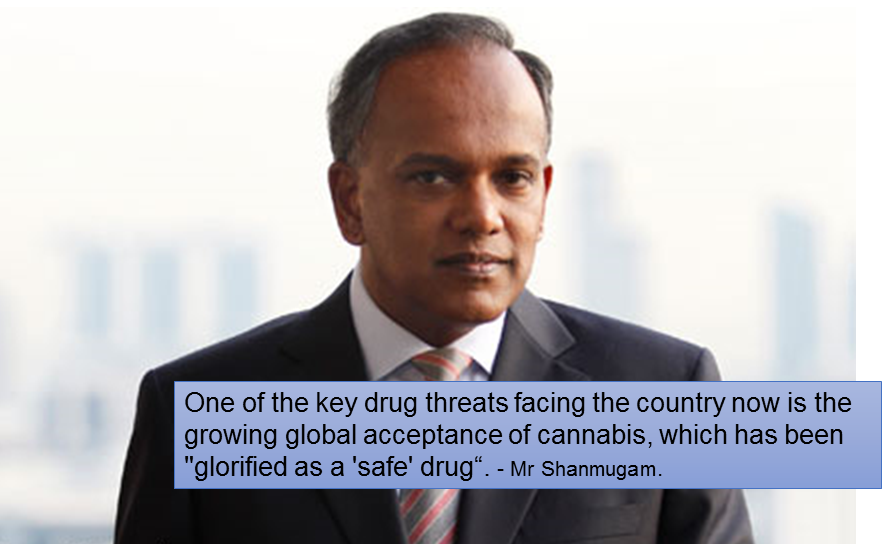
One of the key drug threats facing the country now is the growing global acceptance of cannabis, which has been "glorified as a 'safe' drug", said Mr Shanmugam.

Mr Shanmugam rubbished the claim that there was medical basis for using cannabis.

"This is hogwash because this is the (cannabis) industry trying to present an acceptable reason for using cannabis," he said.

He pointed out that IT WAS OFTEN SO-CALLED "HUMAN RIGHTS" GROUPS, INSTEAD OF MEDICAL BODIES, ADVOCATING THE DRUG'S USE.

Instead, the evidence is to the contrary. A study last year by the Institute of Mental Health found that cannabis abusers risked irreversible brain damage and psychiatric disorders. One in two of those who abuse cannabis daily will go on to develop an addiction.

But as cannabis culture was being promoted through foreign films, documentaries and even supported by celebrities, it made the situation "extremely challenging".

More young Singaporeans also travel abroad and may experiment with drugs overseas, before bringing their habits back home.

In Singapore, cannabis has been increasingly ensnaring young, often well-educated, abusers.

Latest statistics from the Central Narcotics Bureau show that it is now the second most-used drug by new abusers, after methamphetamine. More than two-thirds of new abusers were below 30.

http://www.straitstimes.com/singapore/drug-situation-is-under-control-why-should-we-legalise-drugs

Tuesday, 3 May 2016

Eight radicalized male Bangladeshi nationals detained under ISA


Eight radicalized male Bangladeshi nationals were detained under the Internal Security Act (ISA) in April this year.

The group posed a security concern to Singapore because of its support for ISIS and its readiness to use violence overseas. The detained ISB members are still under investigation for their activities in Singapore.

And what was it that SDP is fighting for again?

http://bit.ly/1SVQUPY

Monday, 25 April 2016

Water is Precious. EVERY DROP COUNTS. Don't waste it!


This should be our concern today.

Currently, water from Johor River helps to meet half of Singapore’s water needs before we become self-sufficient in 2060.

The water plant in Johore cannot treat saltwater.

The Linggiu Reservoir, built in 1994, enables Singapore to reliably draw water from the Johor River by releasing water into the river to prevent saltwater intrusion from the sea into the river.

However, the water level at Linggiu Reservoir in Johor has been rapidly falling to historic lows, raising the possibility that Singapore would be unable to import any water.

At the start of last year, the water level was about 80%. Eight months later it receded to 54.5%. It dropped to 43% in November last year. Last week it was 36.9%. This week it fell to a new historic low of 35%.

While Singapore and Malaysia enjoy good relations and have a treaty in place, Professor Asit Biswas, distinguished visiting professor at the Lee Kuan Yew School of Public Policy (LKYSPP) noted that the supply of water from Johor can by no means be taken for granted.

Prof Biswas, who won the Stockholm Water Prize — considered the water industry’s Nobel Prize — a decade ago, noted that there is a high probability of the region experiencing a serious drought in the coming decades.

And if that happens, “would the politicians and people (in Malaysia) be willing to send that water to Singapore or say it’s an act of God, they really cannot send water and they need to use it themselves? I don’t know”, he said.

Source: Today


Saturday, 23 April 2016

A Poem by Edwin Thumboo on Mrs Lee Kuan Yew


I knew Mrs Lee Kuan Yew slightly, enough to know her genuine deep kindness. She took the trouble to return my mugshot and fingerprints taken by the Criminal Investigation Department in May 1954.

I was on the editorial board of the University of Malaya's University Socialist Club newsletter Fajar ("dawn"). The British colonial authorities charged eight of us with sedition over an article in Fajar.

We were defended by Mr D.N. Pritt, Queen's Counsel, assisted by Mr Lee Kuan Yew. There was absolutely no reason for her to have done so. But that is the measure of the lady.

- Edwin Thumboo

Friday, 22 April 2016

K Shanmugam: No soft approach to drugs


Minister for Home Affairs and Law K. Shanmugam told world leaders at the United Nations that the city state will not soften its drug policies, pushing back against calls from some nations to change its approach to dealing with drugs.

Mr Shanmugam said he was unmoved by the rhetoric he had heard at the meeting. He stressed that Singapore would stick with its approach until there is evidence that a different model works better.
"We are not very impressed with rhetoric alone. Good speeches are one thing. Enjoying safety and security, to the level I have identified - letting your 10-year-old child take public transport alone - that is different."

"I say to anyone with a different view - come forward. I am prepared to compare our experiences with any city that you choose. Show us a model that works better, that delivers a better outcome for citizens, and we will consider changing. If that cannot be done, then don't ask us to change," he added.

Mr Shanmugam rejected the dichotomy presented between human rights and oppression.

"Maybe this rhetoric is based on the experiences in some countries. To us, it sounds like a lot of straw man arguments. Because it's not based on facts."

He stressed that there was a middle road between "locking everyone up, treating them as criminals, and feeding them with drugs".

"It is possible to work with drug abusers to rehabilitate them. This is difficult and resource-intensive. But because every life is important, we do that. Legalising and giving abusers drugs is the easier option. But not the better one," he added.

"You wouldn't knowingly and happily give drugs to your teenage children, would you? You might accept it and deal with it if they abuse drugs. But you wouldn't voluntarily give it. So let's be clear about the harmful effects of drugs," he said.

And while Mr Shanmugam noted the need for a global consensus on how to tackle the drug problem, he also said that every country has the right to choose the approach that works best for it.

"For us, the choice is clear. We want a drug-free Singapore, not a drug-tolerant Singapore," he said.

Source: ST