Friday, 3 June 2016

Four Things About The White House State Dinners


Founding Prime Minister Lee Kuan Yew was hosted to three White House State Dinners during his time as Prime Minister - 1973, 1975 and 1985.

Four things about the White House State Dinners

1. ORIGIN


When it was first initiated in the 19th century, the term “State Dinner” was used to denote any affair that honoured the President’s Cabinet, Congress, or other dignitaries.

In 1874, President Ulysses S Grant changed the meaning of the term when he welcomed King David Kalakua of the Kingdom of Hawaii. These days, state dinners are grand affairs hosted to welcome a visiting head of state or government.

2. INTENSE PREPARATIONS


A state dinner requires months of preparation, sometimes a minimum of six months. Thorough research is conducted to celebrate the guest of honour’s country, culture, and preferences. Hallmarks of American culture are also chosen, often by the First Lady, and these considerations are translated — with approval by the First Lady, State Department and White House Social Secretary — into invitations, menus, guest lists and entertainment.

White House state dinners are not only lavish affairs, they’re “bigger than the biggest weddings,” former White House chef Walter Scheib once said. “State dinners (are) not just an opportunity to show off American hospitality,” he wrote in his book White House Chef: Eleven Years, Two Presidents, One Kitchen. “They are a chance to parade American food and wine before the world.”

3. RARE EVENT


Under President Obama, State Dinners have become quite rare. He and the First Lady have held only 11 state dinners thus far, beginning with then-Indian Prime Minister Manmohan Singh in 2009. The Obama’s most recent State Dinner was an unusual joint affair: With the five leaders of Denmark, Finland, Iceland, Norway and Sweden.

Among modern-day US presidents, Mr Harry Truman was said to have held the least number of State Dinners — just six in about eight years, while Mr Lyndon Johnson’s record of 54 State Dinners in 62 months has yet to be surpassed.

4. HIGH COSTS


The general price tag of a State Dinner is US$500,000 (S$687,736.20). In 2015, it cost about US$590,000 (S$810,877.94) to remodel the White House’s State Dining Room, the venue for the event.

But costs can often vary. According to the Washington Examiner, the Obama White House reportedly spent nearly US$1 million on the State Dinner for Mexico’s then-president Felipe Calderon, which included a performance by Beyonce.

Source: TODAY

SPEECH BY PRESIDENT GERALD FORD: White House State Dinner 1975 in honour of then PM Lee Kuan Yew


WE ARE here, all of us this evening, to welcome to Washington the very distinguished Prime Minister and Mrs. Lee of Singapore, and we are delighted to have both of you here, Mr. Prime Minister and Mrs. Lee.

Regrettably, I have not yet had the opportunity, Mr. Prime Minister, to visit Singapore, and unfortunately, until this morning, I had never had the opportunity to get acquainted with you and to exchange views with you. But obviously, because of your reputation and your country's reputation, I have known both of you.

And I must say that the reputation of both the country and yourself is carried very far throughout the world. In its brief existence, Mr. Prime Minister, a decade of independence, Singapore has compiled a tremendous reputation and record of accomplishment.

Asian traditions have blended in this case very successfully with modern technology to produce a prosperous and a very progressive society without sacrificing a distinctive cultural heritage.

Singapore has built for itself a position of great respect and influence in Southeast Asia and throughout the rest of the world, and I have noticed that in my many contacts with other leaders in the Commonwealth as well as elsewhere.

As the principal architect of this success, the Prime Minister has become widely known, not only for what Singapore has accomplished under his leadership but also for his very broad grasp of international relationships.

Over the last decade, he has achieved a very special status among world leaders for his very thoughtful and his articulate interpretations of world events. He is a man of vision whose views are very relevant to world issues and whose advice is widely sought.

When the Prime Minister speaks, we-all listen most carefully for good and sufficient reasons, and we come away from those experiences far wiser.

And I am especially pleased that we have an opportunity to exchange views with the Prime Minister at this time. We have had a tragedy in Indochina. It is affecting all of the countries in Southeast Asia, as well as all of us who are deeply concerned for the future of Southeast Asia and for the cause of freedom. It has made the problems of Southeast Asia much more difficult. But let me say without reservation, we are determined to deal affirmatively with those problems, and we will deal with them.

The Prime Minister's visit gives us the benefit of his experience and his wisdom in assessing the current situation in that part of the world. It also gives me the opportunity to assure him that our commitments in Southeast Asia and elsewhere, if I might add, are honored and will be honored, and that our concern for the security and for the welfare of free nations in Southeast Asia is undiminished.

Mr. Prime Minister and Mrs. Lee, it is a great pleasure for Mrs. Ford and myself to have you here with us this evening and at last to have an opportunity to have an acquaintanceship and a fine evening with you. Both Mrs. Ford and I have looked forward to this for some time.

Ladies and gentlemen, I ask you now to raise your glasses .and join with me in offering a toast to the Prime Minister of Singapore and to Mrs. Lee.

http://www.presidency.ucsb.edu/ws/?pid=4904

#rememberingLeeKuanYew
#proudtobeSingaporean
#ThankfulAndGrateful
#WeWillNotForget

White House State Dinner 1973: SPEECH BY PRESIDENT RICHARD NIXON in the exchange of toasts between President Richard Nixon and PM Lee Kuan Yew

"Singapore is the best run country in the world." And here is the man who runs it. 


Mr. Prime Minister, Mr. Vice President, ladies and gentlemen:

We have welcomed many very distinguished guests in this room, and I would say that none is more deserving of our respect and of being honored, as we honor him tonight, than the Prime Minister and, I may say, his wife.

I recall the occasions that we have met previously in his country and also here, and I recall also the enormous impression that the Prime Minister has made on various emissaries from the United States who have visited his country. The Vice President and Mrs. Agnew have had the opportunity to visit Singapore, Secretary Rogers and Mrs. Rogers. I have not, since coming into this office.

I think perhaps the best summary of the attitude of all of those who have visited Singapore during the past 3 to 4 years, since I have been having rather regular reports on the situation, was when Secretary Connally returned from his trip around the world when he was Secretary of the Treasury. He came into my office and said, "Singapore is the best run country in the world." And here is the man who runs it.

I would add to that, however, by saying that the best run country in the world could mean a country that was run very well without freedom, because I suppose that if you look at countries around the world, those that have the least obvious problems are those that have no freedom, and therefore, it would be the best run.

And the Prime Minister tonight deserves our honor and our respect, because in this relatively new country with a very old history and a very able people, he has been able to run it well, but run it with respect for the great traditions of freedom which our two countries both adhere to, and for this, we all, of course, hold him in very high regard.

On the two previous occasions he has been here since I have been in this office, he came alone, and, consequently, on one occasion we had a stag dinner. This time, fortunately, he brought Mrs. Lee with him. Now, I had read something about their courtship. I knew that, like Secretary Rogers and Mrs. Rogers, they had gone to school together, they had both graduated from law school in the same class, and so tonight, very early in the evening, when you saw me turning to Mrs. Lee, I said, "Mrs. Lee, tell me, is it true that you were number one in the class at Cambridge Law School and your husband was number two?" And she said, "Mr. President, do you think he would have married me if that were the case?"

But I probed further, and I found that, as a matter of fact, Mrs. Lee, our distinguished guest, did receive a first at Cambridge Law School. Her husband did also, but like a very loyal wife, she said, "He had a first with a star after his name, and that is something very special."

But the purpose of that is simply to say that we are very happy here to welcome our distinguished guests because of their personal qualities, because of their great ability, and because of the leadership they have given to their own country.

I would only add this: In the talks that I have had with the Prime Minister, in 1967 when we first met--at a time that neither he nor I had any idea that we would be meeting again today in this place---but in any event, in 1967 when we first met, on the other two occasions, what has impressed me enormously has been his profound understanding, not just of his own country and not just of Southeast Asia, of which his own country is a very important part, but of the entire world scene. In other words, we honor tonight and we welcome here a world statesman of the first rank, who has contributed, with his intelligence, with his understanding, to all of, us, in helping us to develop the kinds of policies that will maintain a world in which freedom can survive for larger countries like the United States and for smaller countries like Singapore.

There is no more articulate and intelligent spokesman for what I would call free societies in the world than the Prime Minister of Singapore, and for that reason I know all of you will want to join me in raising your glasses to Prime Minister Lee. Prime Minister Lee.

http://www.presidency.ucsb.edu/ws/?pid=3802

#rememberingLeeKuanYew
#proudandimpressed

Tuesday, 31 May 2016

What will Singapore be like 20 years from now?


The Singapore 20 years from now will be an innovative and deeply inclusive one, where a new generation of Singaporeans define their own purpose in life, each with a sense of individuality, in a society that is bound together and at home with itself, said Deputy Prime Minister Tharman Shanmugaratnam yesterday.

Painting a picture of what the Republic will be like in 2035, based on a poll of students, he said: "Twenty years from now, we will still be a little red dot, always will be.

"But it will be a deep red dot. The colour of the Singapore heart."

Education, he said, would become more holistic, flexible and encouraging.

A more flexible system and a focus on skills and job performance, rather than qualifications earned early in life, will be needed instead for the fluid job market of the future, noted Mr Tharman.

Citing an informal survey MOE did to find out the aspirations of seminar participants, Mr Tharman noted that students ranked job satisfaction and the ability to make the most of one's talents, above factors like pay and career progress. Most also felt the Singapore of the future has to be innovative and inclusive.

Whether or not these aspirations could be met would depend on how Singapore reacts to changes in areas such as technology and geopolitics, said Mr Tharman.

Some jobs - such as software engineers, data scientists and healthcare professionals - could be in demand, while demand for lawyers, accountants and real estate or insurance agents could taper off.

While there is a "real fear" in many advanced countries that the jobs lost will outstrip the jobs created, Singapore can avoid that by responding in advance to what is coming, said Mr Tharman.

Studies show it is more productive for humans to "cobot" - collaborate with robots - than to have enterprises that rely purely on humans or robots alone.

Education will also evolve, with a premium on original thinking, which breeds the innovative spirit.

The way students and parents go about selecting schools will change, he said, with people valuing schools that develop their interests rather than schools with the highest cut-off scores.

But there is a "deeper tension" between innovation and inclusiveness, said Mr Tharman.

**While young Singaporeans will have a stronger sense of individuality, Singapore must not become an individualistic society but maintain a "spirit of solidarity" with "diversity of thinking" .

"It is a tension, but how this plays out depends on us," said Mr Tharman.

Mr Tharman was speaking at the opening ceremony of the Pre-University Seminar held at the Nanyang Technological University.

http://www.straitstimes.com/singapore/spore-in-2035-inclusive-and-innovative

MEDIA CENSORSHIP: Not the only test for a liberal progressive society


There is more freedom now compared to a decade ago, “let alone when I was your age”, said Mr Tharman. “I was a dissident, a government critic. It was completely different then, compared to where it is now. We have evolved into a society that has more freedoms, but it has some restrictions and they serve a purpose.”

He was speaking at a Pre-University Seminar on May 30 2016.

Singapore society should evolve towards more freedom of speech but some restrictions, such as on hate speech, are necessary.

Enforcement against hate speech does not mean all comment and expression is scrubbed out, but individuals have to be responsible, he said.

Mr Tharman spoke of the need to let values in Singapore “evolve quietly”, instead of having a debate to decide on values for the future, because that was not how societies evolved.

Each generation, he added, would have its own sense of purpose and values, but rarely totally divorced from their parents’ or grandparents’.

Media censorship, Mr Tharman said, was not the only test of a liberal, progressive society.

In some countries with looser reins on the media, there is much less freedom to walk safely on the streets and to advance oneself regardless of ethnicity or religion, he said.

Society has to find the right balance and some freedoms have to be curbed for it to evolve in a way that advances other freedoms, he said. “Every society faces this. We haven’t found the perfect balance, and we have to keep evolving.”

http://www.todayonline.com/singapore/more-freedom-speech-some-restrictions-necessary-dpm

Monday, 9 May 2016

Key drug threats facing Singapore


There is a growing calls for countries to legalize drugs and to adopt "harm reduction" approaches, that is, minimise the harms associated with drug use.

And THAT includes providing clean needles for drug abusers and safe, supervised injection sites.

So taxpayers will be funding some people's drug habit and addiction??

And this would be unacceptable to the majority of Singaporeans, said Mr Shanmugam.

Much of the impetus for harm reduction was coming from countries which were either major drug producers or have been affected by a large number of drugs flowing through their system and they are unable to cope with it anymore.

But Singapore is not in such a position.

Without its strict laws, the country would be swamped with drugs.

The Republic is near the Golden Triangle of Myanmar, Laos and Thailand - the second largest heroin production centre in Asia.

Singapore's standing as an international hub means even drugs from Afghanistan - another major heroin producer - could end up here.

"The death penalty for traffickers, in our experience, has played a key role in combating drug trafficking. This is part of Singapore's framework of laws, coupled with effective enforcement based on rule of law," said Mr Shanmugam.

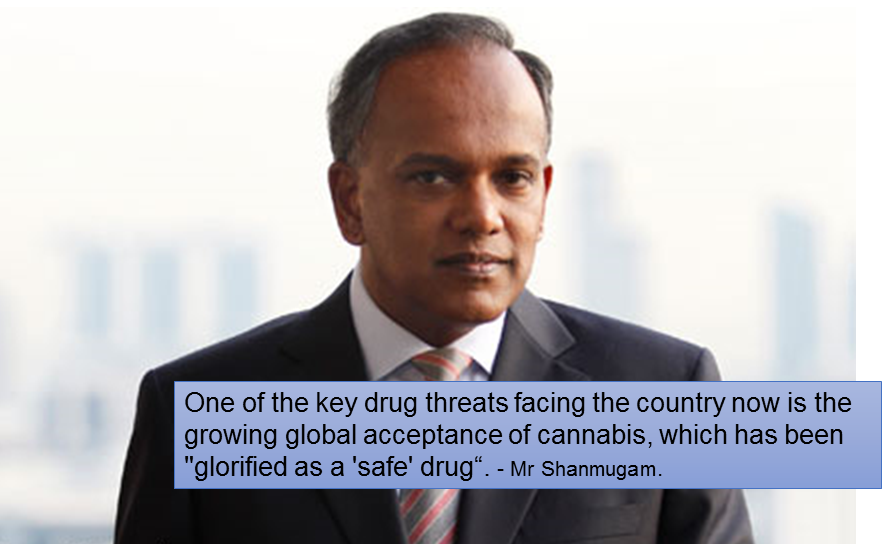
One of the key drug threats facing the country now is the growing global acceptance of cannabis, which has been "glorified as a 'safe' drug", said Mr Shanmugam.

Mr Shanmugam rubbished the claim that there was medical basis for using cannabis.

"This is hogwash because this is the (cannabis) industry trying to present an acceptable reason for using cannabis," he said.

He pointed out that IT WAS OFTEN SO-CALLED "HUMAN RIGHTS" GROUPS, INSTEAD OF MEDICAL BODIES, ADVOCATING THE DRUG'S USE.

Instead, the evidence is to the contrary. A study last year by the Institute of Mental Health found that cannabis abusers risked irreversible brain damage and psychiatric disorders. One in two of those who abuse cannabis daily will go on to develop an addiction.

But as cannabis culture was being promoted through foreign films, documentaries and even supported by celebrities, it made the situation "extremely challenging".

More young Singaporeans also travel abroad and may experiment with drugs overseas, before bringing their habits back home.

In Singapore, cannabis has been increasingly ensnaring young, often well-educated, abusers.

Latest statistics from the Central Narcotics Bureau show that it is now the second most-used drug by new abusers, after methamphetamine. More than two-thirds of new abusers were below 30.

http://www.straitstimes.com/singapore/drug-situation-is-under-control-why-should-we-legalise-drugs

Tuesday, 3 May 2016

Eight radicalized male Bangladeshi nationals detained under ISA


Eight radicalized male Bangladeshi nationals were detained under the Internal Security Act (ISA) in April this year.

The group posed a security concern to Singapore because of its support for ISIS and its readiness to use violence overseas. The detained ISB members are still under investigation for their activities in Singapore.

And what was it that SDP is fighting for again?

http://bit.ly/1SVQUPY